
Article 1
Inside China’s
Robotics Ecosystem:
The Humans Behind Physical AI
Norda’s field notes from Shenzhen and Hong Kong: talent, training data and the environments where physical AI will have to work.
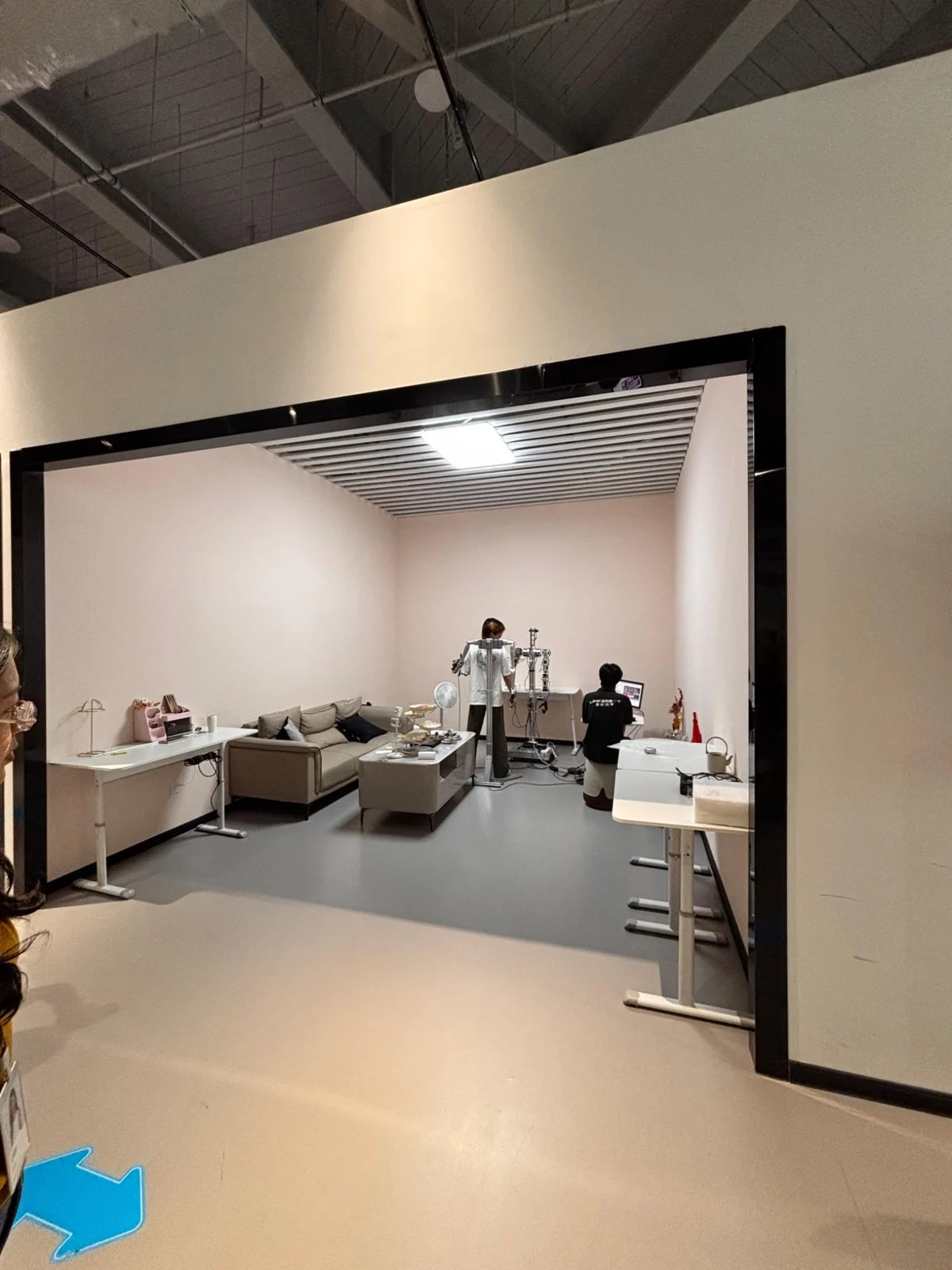
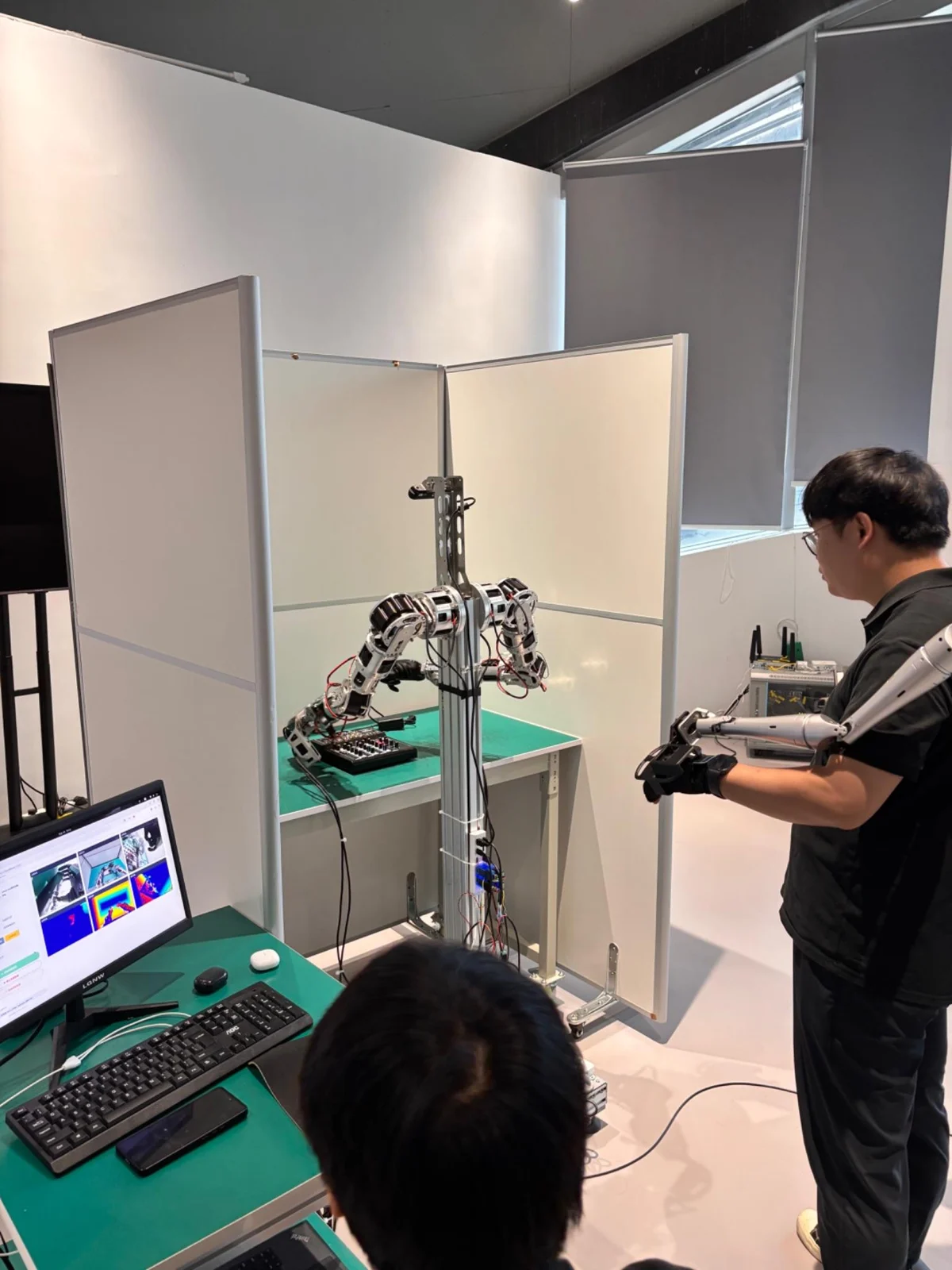
At Linkerbot, three recreated rooms brought a little of the home into a robotics workspace. Nearby, people were teleoperating the company’s dexterous robotic hardware.
It was one of the scenes that stayed with us during 25 days of visits and conversations across Shenzhen and Hong Kong. Alongside the machines were people doing the patient work of teaching, demonstrating and collecting. For Norda, that human effort is central to the story of physical AI.
Our conversations focused on the practical questions behind training data collection: which tasks matter, which environments are needed, and what makes a demonstration useful to the team receiving it.
Between company visits, an architect’s spotting scope and an unexpected conversation with Will.i.am in an electronics market gave us other ways to look at the city. The trip took us well beyond our original meeting agenda.
Capital is arriving while the recipe is still being written
Physical AI is attracting substantial capital while researchers continue to work out how to teach robots to handle unfamiliar tasks and environments reliably. Our reading of the published work is that there is still no single settled training recipe for general-purpose robots. Companies are developing different combinations of human demonstrations, robot experience and simulated data, alongside different ways of helping a trained model adapt to new work.[1]
The approaches overlap, but their emphasis differs. Among the companies we met, DexForce describes a strategy combining world models, physics simulation and deployment on real robots.[5] BridgeDP describes collecting whole-body motion data and using feedback from model failures to guide subsequent collection.[8] Internationally, Physical Intelligence’s RECAP combines demonstrations, human corrections and robot experience, while Skild AI’s S1 explores adapting to tasks through video demonstrations supplied to an already-trained model.[1] Each approach has implications for what must be recorded and how it will be used.
The investment behind that search was visible in the public financing announcements of the companies on our meeting agenda. In June 2026, AI² Robotics was reported to have completed a series of new financings totalling nearly RMB 5 billion. DexForce announced a RMB 1 billion Series B that same month.[5] Linkerbot’s February Series B was reported at nearly RMB 1.5 billion; a further B+ round followed in April.[6] BrainCo, whose focus includes brain-computer interfaces and bionic products, was reported in January to have raised approximately RMB 2 billion.[7]
Capital was also reaching the infrastructure behind robot learning. Noitom Robotics announced a Pre-A++ round of several hundred million RMB in June, with funding directed towards multimodal data collection, processing and delivery.[9] BridgeDP’s August financing supported plans that included expanding its whole-body motion data factory.[8] Zerith, meanwhile, announced more than RMB 100 million in new funding in April.[10]
The international backdrop reinforces the scale: three rounds announced by Physical Intelligence, Skild AI and Apptronik between November 2025 and February 2026 totalled $2.52 billion.[2] In China, the figures gave context to the teams, equipment and collection operations we were seeing up close.
For Norda, this combination of investment and ongoing research reinforces the need to tailor training-data collection to each company’s approach. The question is what a particular team needs its model to learn, and which data can help it get there.
Going where the conversations are
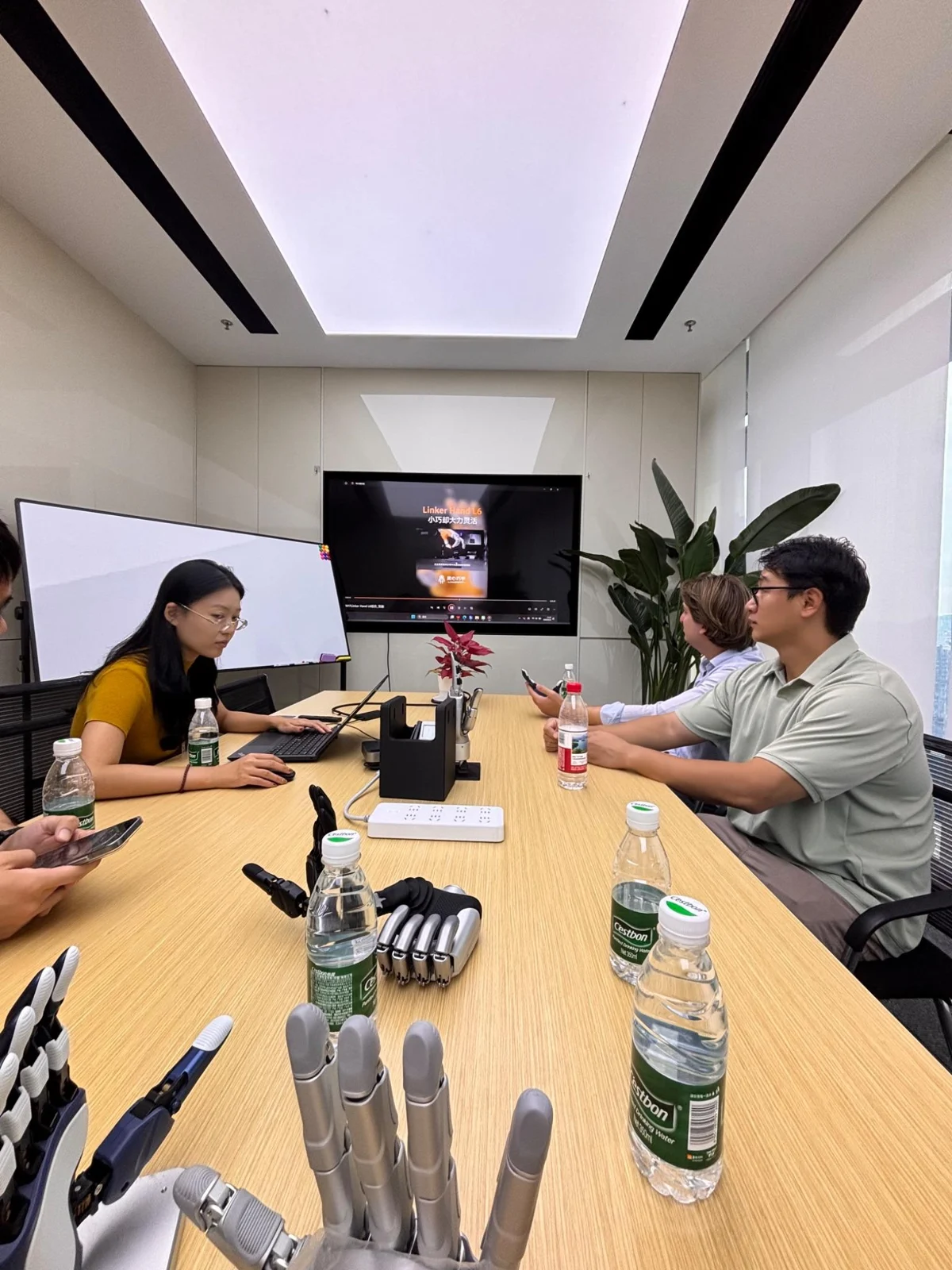
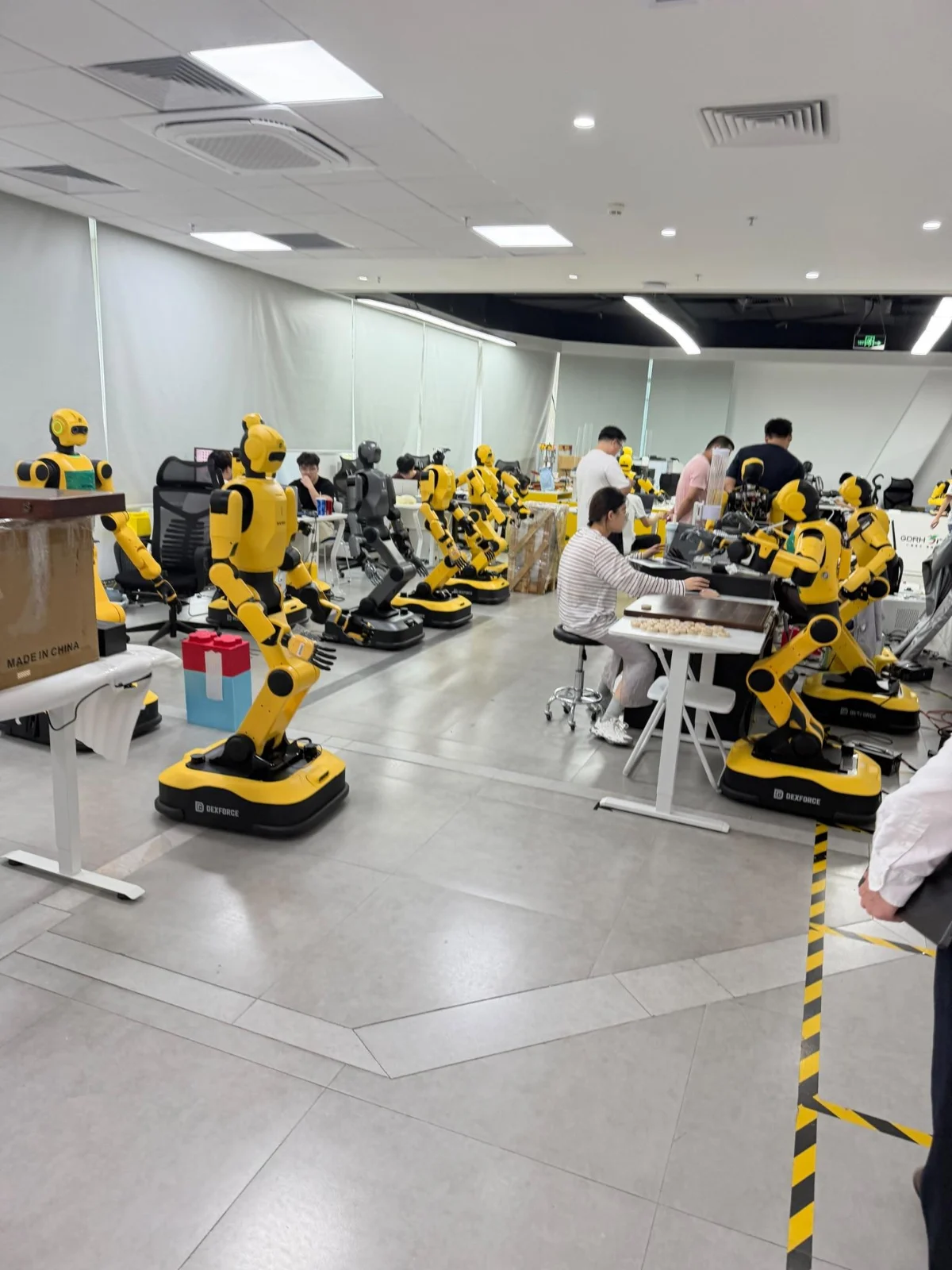
Understanding how different teams approach those questions means spending time with the people working on them. Most of the companies we visited were based in Nanshan, the Shenzhen district whose economy crossed RMB 1 trillion in 2025, growing by 6.3% in real terms.[11] Robotics is developing here within an established technology economy, with universities, suppliers and experienced engineering teams close at hand.
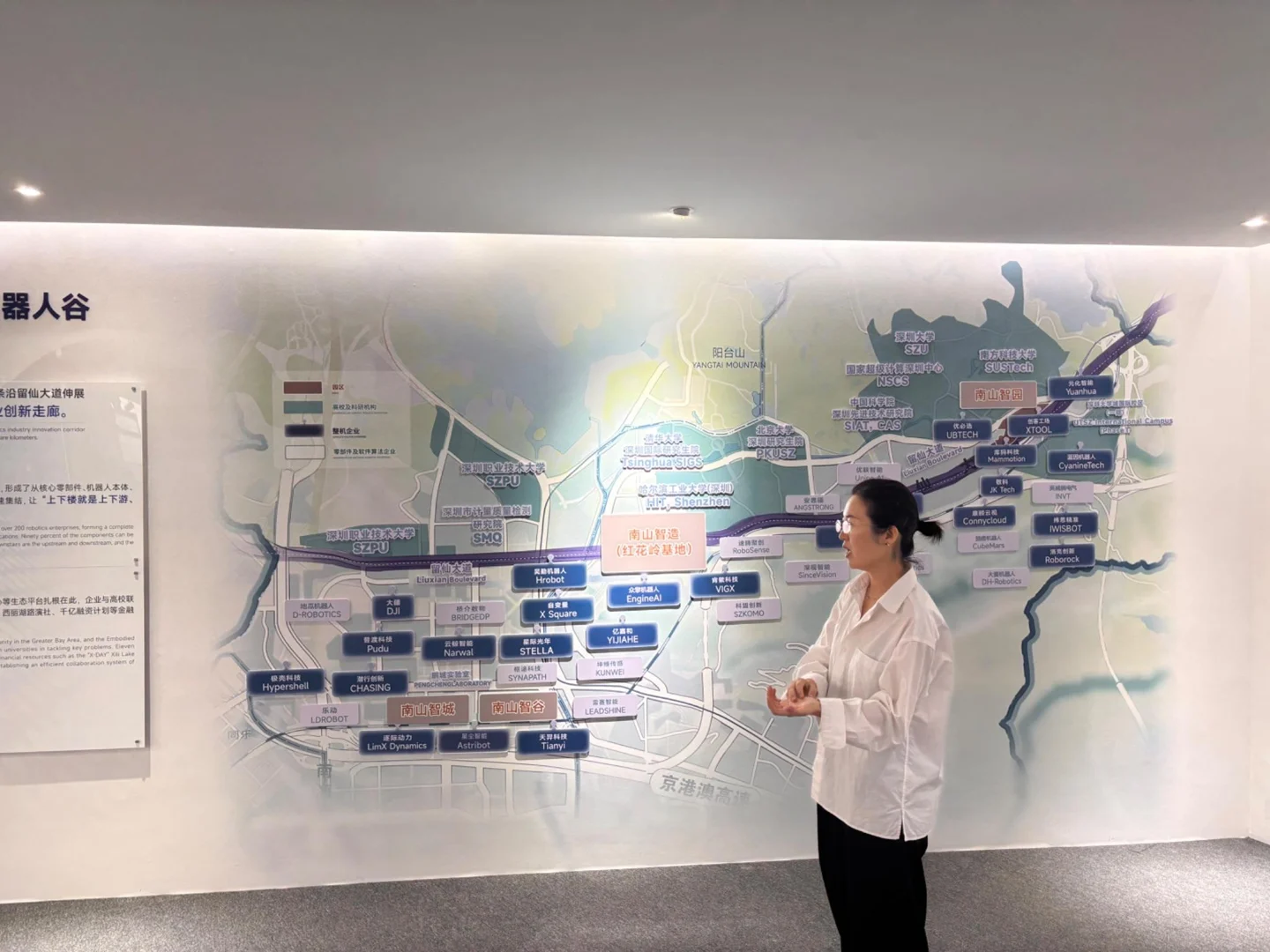
Within Nanshan, a roughly ten-kilometre corridor along Liuxian Avenue has become known as “Robot Valley”. It brings robotics companies, research institutions and university campuses into close proximity.[12] At Robotuo’s showroom, a wall-sized map made that concentration tangible. Company names we had been discussing throughout the trip appeared together across the same stretch of the city.
Towards the end of our stay, we attended an event where Robotuo presented its new website, bringing together a directory of robotics companies and robot models, including humanoids.[13] Founder Tuo Liu and his team deserve credit for making this fast-moving industry easier to navigate. For readers trying to understand who is building what, robotuo.com offers a useful starting point.
Beyond Shenzhen, national shipment figures give a sense of the industry’s scale. Smart Analytics Global estimates that Chinese vendors accounted for more than 97% of global humanoid shipments in the first half of 2026, out of approximately 19,100 units worldwide.[3] That is a measure of shipment scale, while the capabilities and applications of the machines remain separate questions.
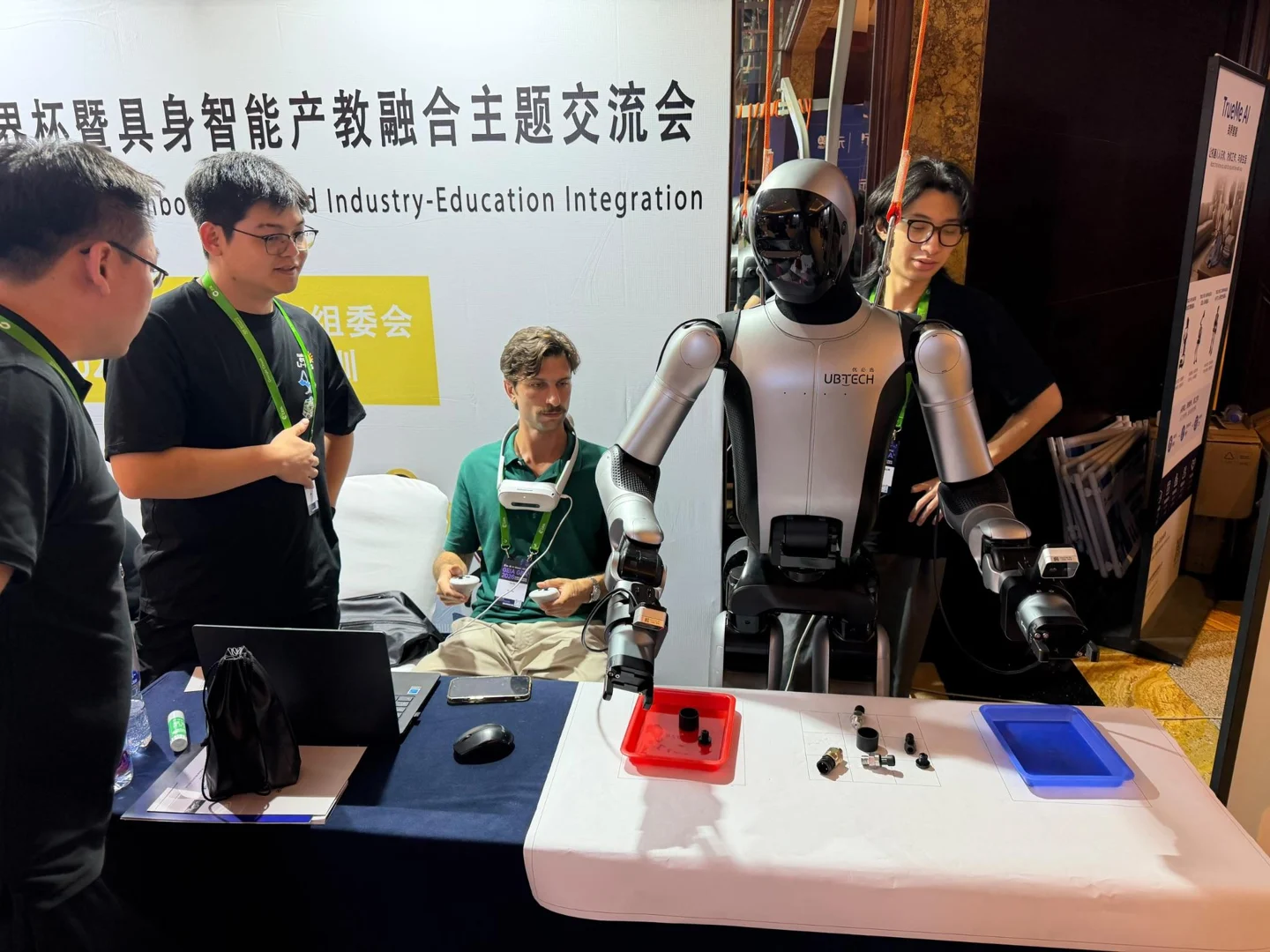
Seeing demonstrations in person brought that distinction into focus. Some were impressive. Others left us wondering how much the robot could manage when the task or surroundings changed. A performance built to capture attention offers only a partial view of that ability. The questions behind it matter: how much was rehearsed, what was remotely controlled, and what could the machine do without human intervention? For us, the more compelling milestone is a robot that can handle unfamiliar situations, recover from mistakes and complete useful work reliably. Progress is real, but general-purpose humanoids are still far from operating reliably across unfamiliar, open-ended environments. Those limitations matter when defining what their training data needs to capture.
Our own route took us into conversations with teams at AI² Robotics, BrainCo, BridgeDP, DexForce, Noitom, Linkerbot, Zerith and many others. Across those meetings, one detail kept recurring: many of the people we met had joined their companies only a few months earlier.
That gave the meetings a particular atmosphere, with people bringing fresh energy to their teams, asking questions and taking an active interest in what others were building. Their curiosity was palpable. So was their ambition.
The work behind the demonstrations
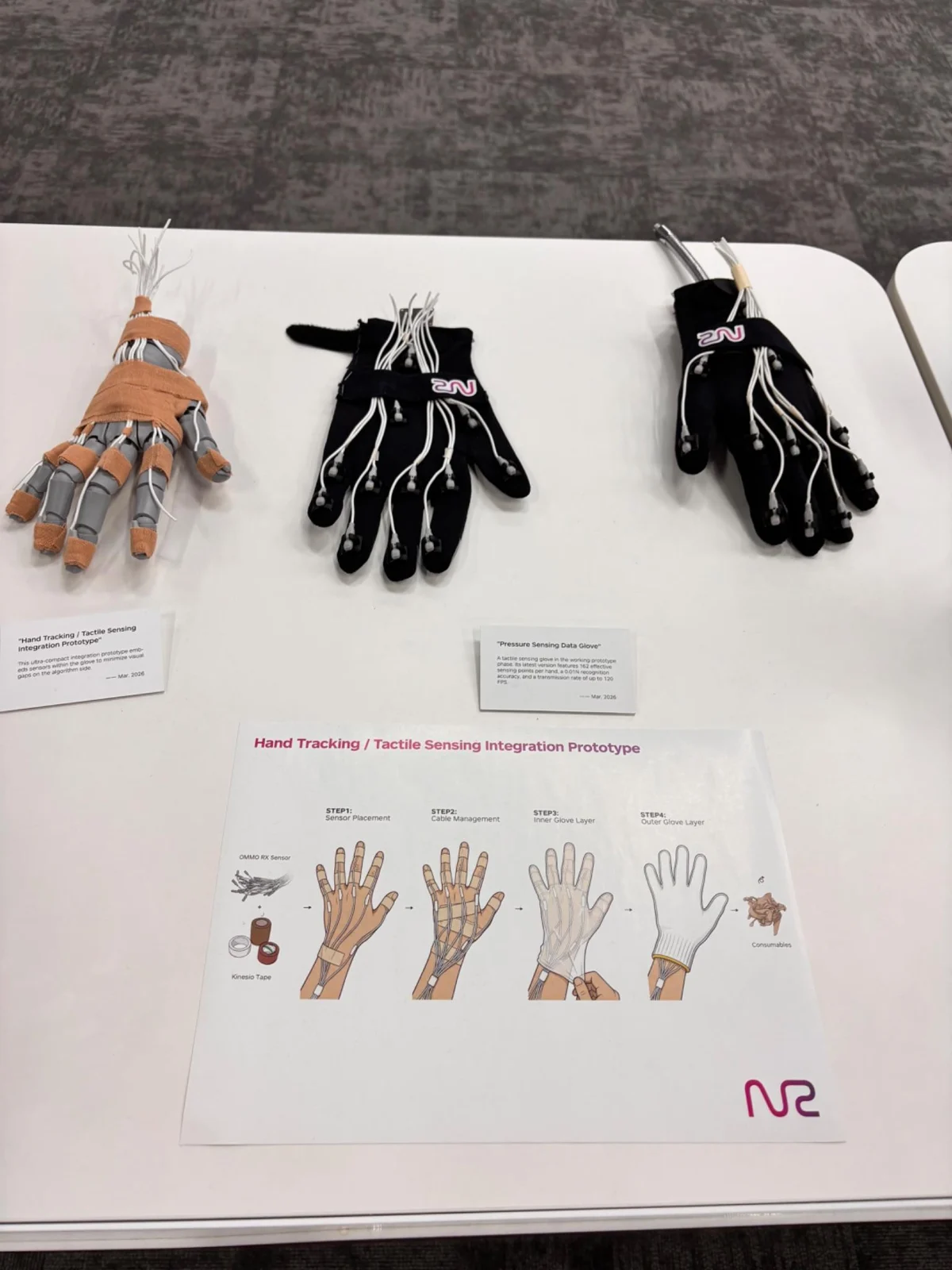
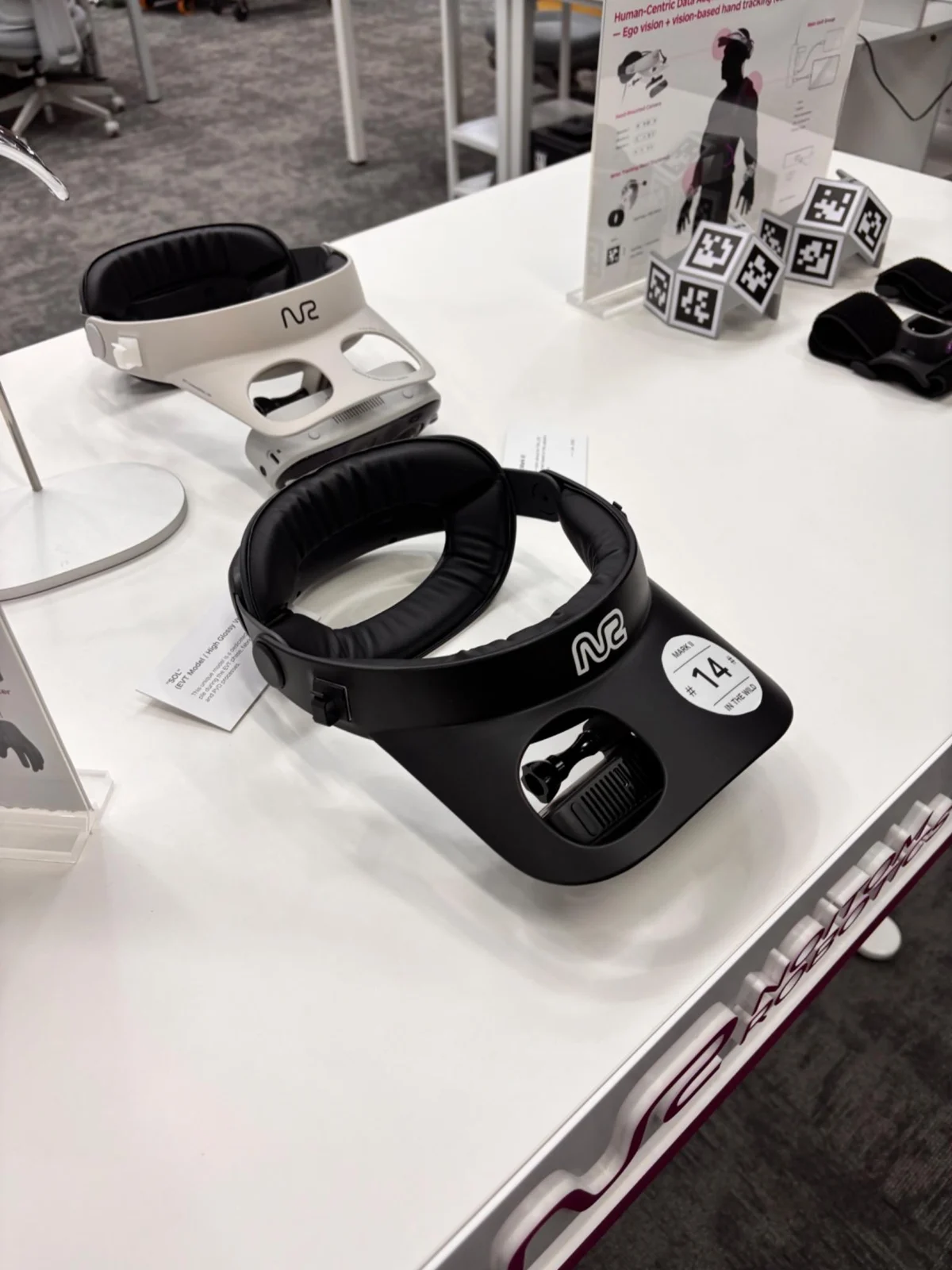
The collection environments were among the most memorable places we visited. They brought us closer to the work that precedes a robot’s public demonstration: people recording actions, guiding movements and producing examples for machines to learn from.
At Linkerbot, recreated domestic rooms gave that work a familiar setting. Alongside the company’s dexterous robotic hardware, people operated teleoperation systems. It was a scene worth pausing over as the machines attracting so much attention still depend on people to demonstrate the actions they were being developed to perform.
At Noitom, the robots themselves were absent from the space we saw. Motion-capture equipment and infrared tracking systems took centre stage. After so many robot demonstrations, it was striking to visit a place where the focus was on capturing human movement. Photography was not permitted, but the visit stayed with us: here was another part of the effort to teach machines how to act, beginning with a very detailed study of how people move.[4]
Together with others, these visits gave substance to a phrase that can otherwise sound abstract: “training data collection.” Behind it are choices about the activity to record, the equipment to use and the information a learning system will need.
For Norda, those choices are central to our work. A team studying how a person completes a task may need a different recording setup from one learning to control a robotic hand. The task, the environment and the capture method have to fit the buyer’s requirements. Understanding what the model needs to learn is where collection begins.
Between meetings
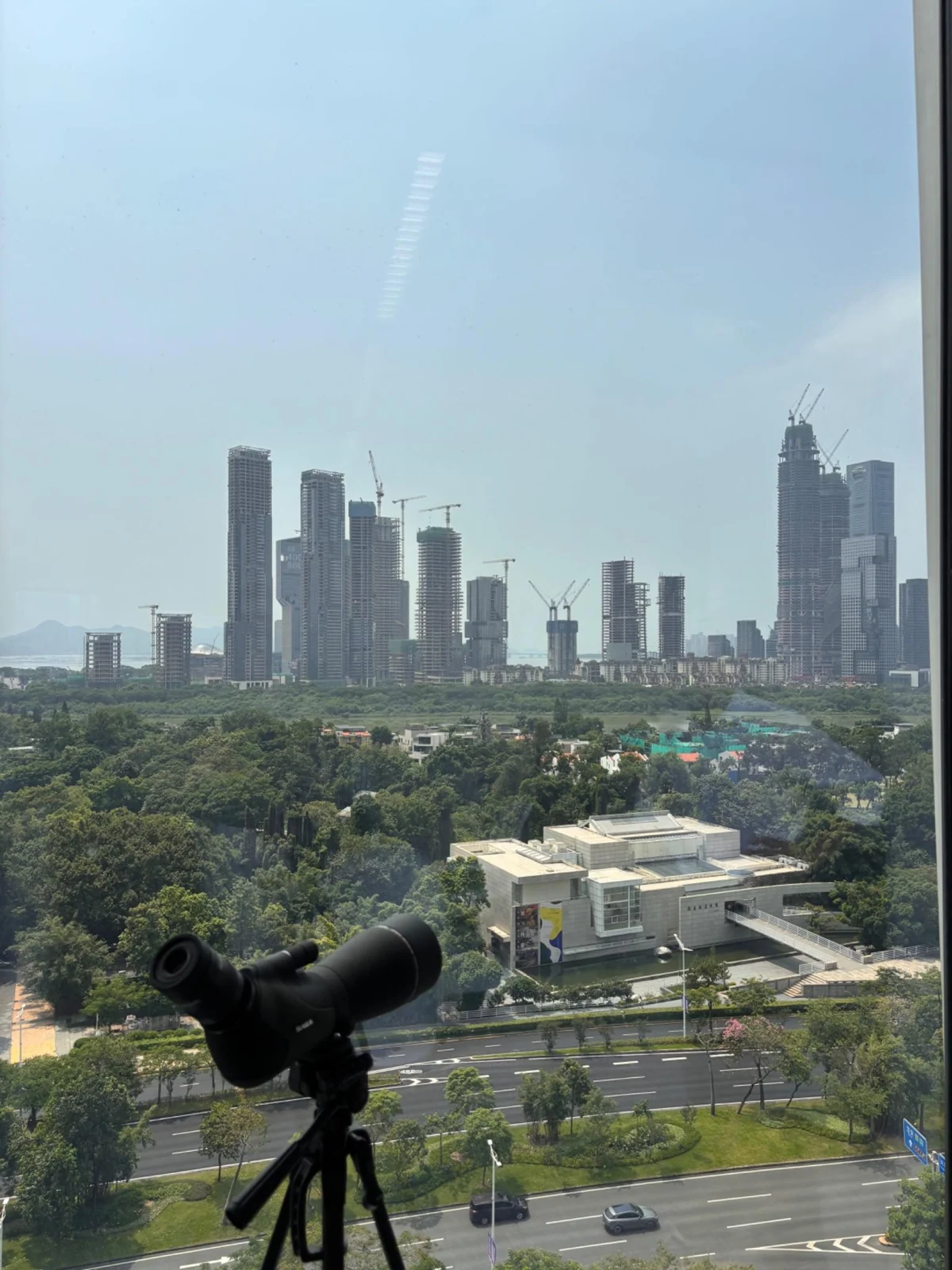
One of the most revealing views of Shenzhen came through a long-range observation scope.
The introduction happened at a bar opening. Someone Lorenzo, one of our co-founders, had met in Shenzhen invited him along, and among the expats gathered there was a senior architect from ZHA (Zaha Hadid Architects). The two ended up talking for more than one hour.
An office visit followed. The architect had spent 16 years with the practice and almost three in China. He showed Lorenzo projects the Shenzhen office was working on and spoke about the effect of the real estate downturn on development funding. Then, using the spotting scope, he pointed out buildings across the skyline that he described as stalled in the aftermath of the crisis. And through this instrument, a story usually told in debt figures and developer headlines became a series of individual buildings. A very concrete image.
That view stayed with us alongside the energy of the robotics teams we were meeting. Spending time in the city made room for both experiences: the enthusiasm of people joining young technology companies, and the perspective of someone working through a much harder period in another industry.
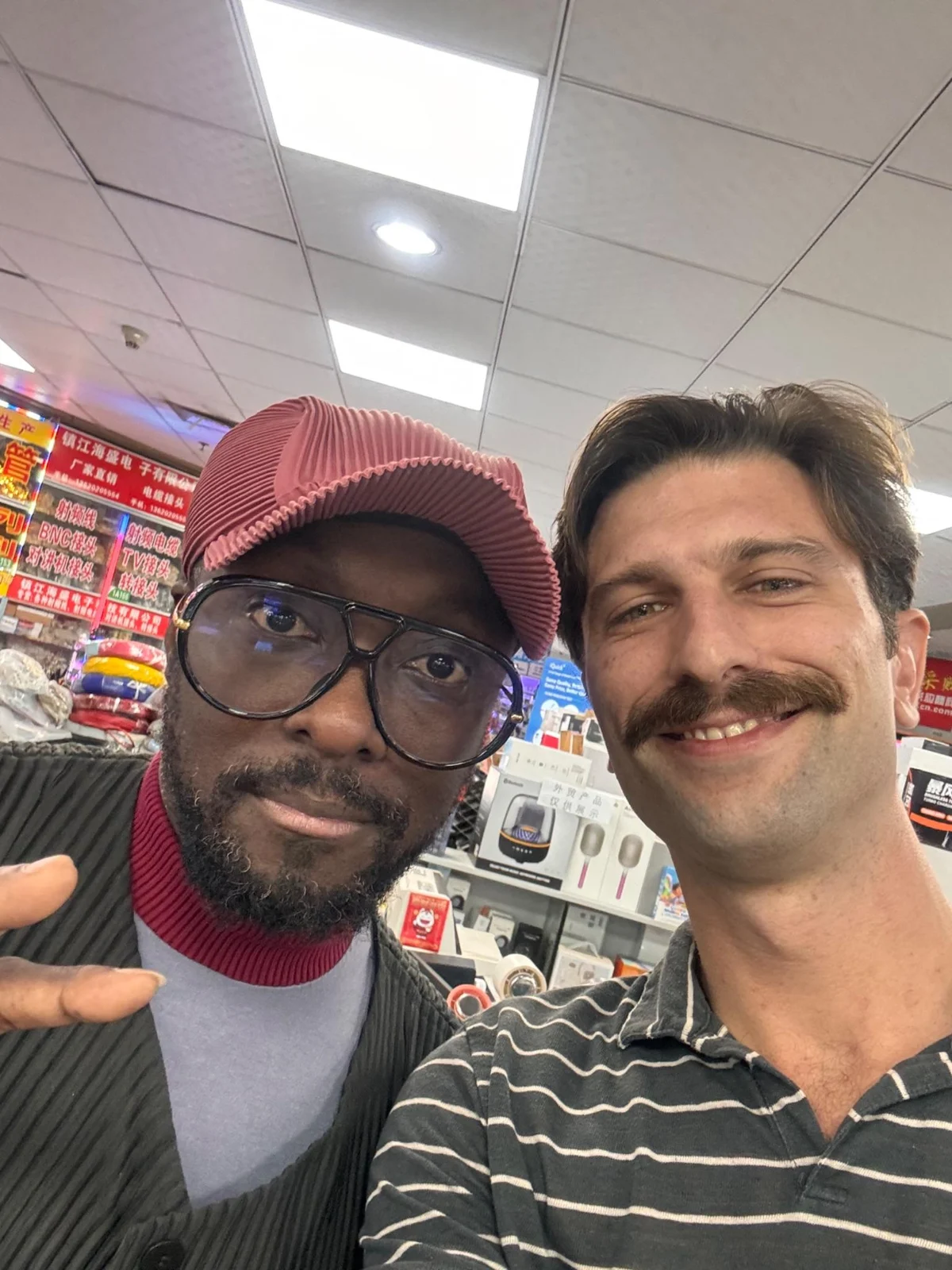
Another encounter began in an unpolished electronics market, well away from the kind of setting where Lorenzo expected to meet a world famous musician.
There was Will.i.am, with two colleagues, in conversation with some local electronics suppliers. By the time Lorenzo approached from behind, he was looking down at his phone.
“Hey man, are you Will.i.am?”
He turned, looked at Lorenzo and, slipping into a playful Michael Jackson impression, replied: “No, I’m Michael Jackson.”
They both laughed. He stood up, and they started talking.
They spent five to ten minutes discussing what had brought each of them to Shenzhen. Lorenzo explained Norda. Will.i.am described work on hardware built around AI agents, with an emphasis on making something people would find useful and engaging beyond its initial novelty.
He also said he hoped to present a first live product by the winter holidays, Lorenzo recalls. It was an ambition shared in an informal conversation, rather than a sneak peek of a formal product announcement.
They took a selfie, of course.
The conversation was brief, but its subject fitted the setting. The question was what to build and why someone would want it. It was a chance encounter with a surprisingly familiar concern: how an idea becomes a product worth using, and not just a nice marketing stunt.
An informal data economy
Another side of the market surfaced in conversations with industry professionals who described brokering data independently alongside their day jobs. These were individual encounters, but they offered a glimpse of an entrepreneurial layer that rarely appears in company presentations. We can call this a ‘hidden economy’.
To us, it was a concrete expression of the hustle around the sector. People identifying opportunities to connect demand with supply and earn a margin in the process. It also raised practical questions for anyone sourcing data through intermediaries. How many intermediaries separate the buyer from the collector? Who actually manages the collection? Who controls the rights, and who can authorise their use?
The value of a specific environment
The most concrete data discussions named places where people already work, including construction sites, shopping malls, retail shops, hotels, and factories producing garments and electronics. Some requests specifically concerned European environments.
Alongside the collection activity we saw in China, those requests highlighted an important distinction: capacity to produce data and access to a particular workflow are separate questions.
For international collection, the useful question is what changes from one setting to another. Equipment, layouts, materials, working practices and the sequence of a task can all be part of the specification. Geography matters when it brings a difference the buyer needs to capture.
Even a familiar label such as “factory data” leaves much undefined. Which process? Which tools? Which actions must remain visible? What variation should the collection include, and what will count as an accepted demonstration?
Those details turn a broad request into an executable collection brief. They also determine which sites, participants and capture methods are appropriate.
That is the focus of Norda’s work: translating buyer-defined requirements into practical plans for real-world, in-the-wild data collection, from sourcing the right environments and securing permissions to coordinating capture, quality control and delivery.
Access is just the starting point. The value lies in collecting the right activity under the right conditions, with clear usage rights and acceptance criteria.
Norda takes particular pride in the international network of companies supporting our collection efforts. These relationships help us secure suitable workplaces, coordinate with site operators and participants, and establish the permissions and data rights required for each program. We take on the operational and contractual work behind real-world collection, acting as a natural extension of our clients’ teams from collection design through delivery.
Understanding each other
Patrick, our co-founder and Director for China, was central to making these conversations possible.
In many meetings, he translated exchanges throughout, kept technical and commercial discussions precise, and navigated the Chinese business etiquette and courtesies on which productive conversations depended. His contribution went well beyond language. It helped ensure that questions, expectations and qualifications survived the translation.
International collection depends on that same care. A specification has to remain clear as it moves between a research team, a site operator and the people carrying out the work. Understanding one another is a crucial part of the pipeline.
Where the work happens
The scenes that stayed with us were grounded in human activity. We saw operators beside robotic hardware, people capturing movement and teams discussing the work they wanted their systems to perform.
Together, they brought a practical dimension to a field often discussed through launch videos, technical milestones, and fundraising announcements. Behind the demonstration is a collection process. Behind the collection process are people, places and decisions about what is worth recording. Physical AI may eventually automate some of the work our economies depend on, but these systems are still being built, taught and evaluated by people.
Norda’s role is to organise that work around a buyer’s requirements: the task, the environment, the equipment, and the standard the delivered data must meet.
For teams seeking data from a specific workflow or commercial setting, the conversation starts there.
Sources
Primary technical sources: Physical Intelligence, π*0.6: a VLA That Learns From Experience, November 2025; NVIDIA, Develop Humanoid Robot Policies End-to-End with NVIDIA Isaac GR00T, including the GR00T 1.7 data mixture and collection/post-training workflow; Skild AI, Introducing S1: In-Context Learning for Robotics, 18 August 2026.
Primary funding sources: CapitalG’s insights index explicitly identifies Physical Intelligence’s $600 million round; its investment announcement is dated 20 November 2025. Skild AI, Series C announcement, 14 January 2026, $1.4 billion. Apptronik, new $520 million extension round, 11 February 2026. Total calculated from those three announced rounds. These are selected funding rounds, not an estimate of total sector investment or valuations.
Smart Analytics Global, 10 August 2026, Global humanoid robot shipments in the first half of 2026. Market-research estimates. Also reported by Global Times, 11 August 2026.
Noitom’s Chinese embodied-intelligence/humanoid-robotics solutions and motion-capture data-factory explanation; Noitom Robotics’ English embodied-AI data overview. These describe the companies’ published offerings, not the confirmed purpose of every system seen during the visit.
AI² Robotics: Jiemian, 29 June 2026, nearly RMB 5 billion across a series of new financings. DexForce: company announcement, 30 June 2026, RMB 1 billion Series B, and its stated world-model, physics-simulation and real-robot strategy. Published strategy is not independent validation of performance.
Linkerbot: CLS / STAR Market Daily, 12 February 2026, nearly RMB 1.5 billion Series B; Reuters, 4 May 2026, completed B+ at a $3 billion valuation. Reuters did not give the amount raised in that B+ round. Its $6 billion figure was a future valuation target.
BrainCo: The Paper, 6 January 2026, approximately RMB 2 billion financing; company response reported on 8 January. BrainCo confirmed financing had occurred while referring detailed terms to formal company disclosures. The amount therefore remains attributed to reporting. This is an adjacent BCI/bionics business, not a claim that the whole raise funds general-purpose robot training.
BridgeDP: company financing and strategy announcement; ChinaVenture, 12 August 2026. Pre-A+++ led by China Mobile Chain Fund, described in Chinese as “亿元级” (on the order of hundreds of millions of RMB), with no precise amount disclosed. The company’s own account describes whole-body motion collection and feeding model failures back into collection planning.
Noitom Robotics: Shanghai Securities News, 15 June 2026, carried by Sina Finance. Pre-A++ of several hundred million RMB; no exact amount disclosed. Financing is attributed specifically to Noitom Robotics, not automatically to every Noitom-branded legal entity.
Zerith / 零次方: PE Daily, 9 April 2026, carried by Sina Finance, more than RMB 100 million, led by Runze Group. Do not confuse Zerith with Zeroth / 灵初, a different company.
Shenzhen government’s report on Nanshan’s 2025 GDP.
April 2025 report explaining Robot Valley’s geography.
Robotuo’s company directory and robot directory.